HeyAmos vs Semrush: Side-by-Side Comparison for AI Search Visibility (2026)
AI search isn’t a curiosity anymore—it’s a measurable discovery channel. Forrester reports 89% of B2B buyers have adopted generative AI, and G2’s 2025 research found 29% of buyers start research on platforms like ChatGPT more often than Google. That shift is why “Do we show up in AI answers?” has moved from a nice-to-have to a dashboard item for CMOs and growth teams.
This guide compares HeyAmos vs Semrush AI Visibility Toolkit (often referenced as an AI SEO toolkit) with a practical lens: coverage, prompts, models, workflow, reporting, and pricing—plus which one fits different team setups.
Quick verdict: which teams choose which?
Choose HeyAmos if you need:
- A CMO-ready report that highlights what matters (where you rank vs competitors in AI answers, what sources drive answers, and which prompts to watch).
- Clear diagnosis of why competitors show up when you don’t, plus prioritized next steps via a data-driven GEO playbook.
- A workflow that can extend into data-driven content creation (automated content agent) and human support from GEO experts.
Choose Semrush AI Visibility Toolkit if you need:
- AI visibility features inside a broader SEO ecosystem (especially if you already run SEO workflows in Semrush).
- Packaged AI visibility reporting (Visibility Overview + Brand Performance report set) and daily prompt tracking in supported AI experiences.
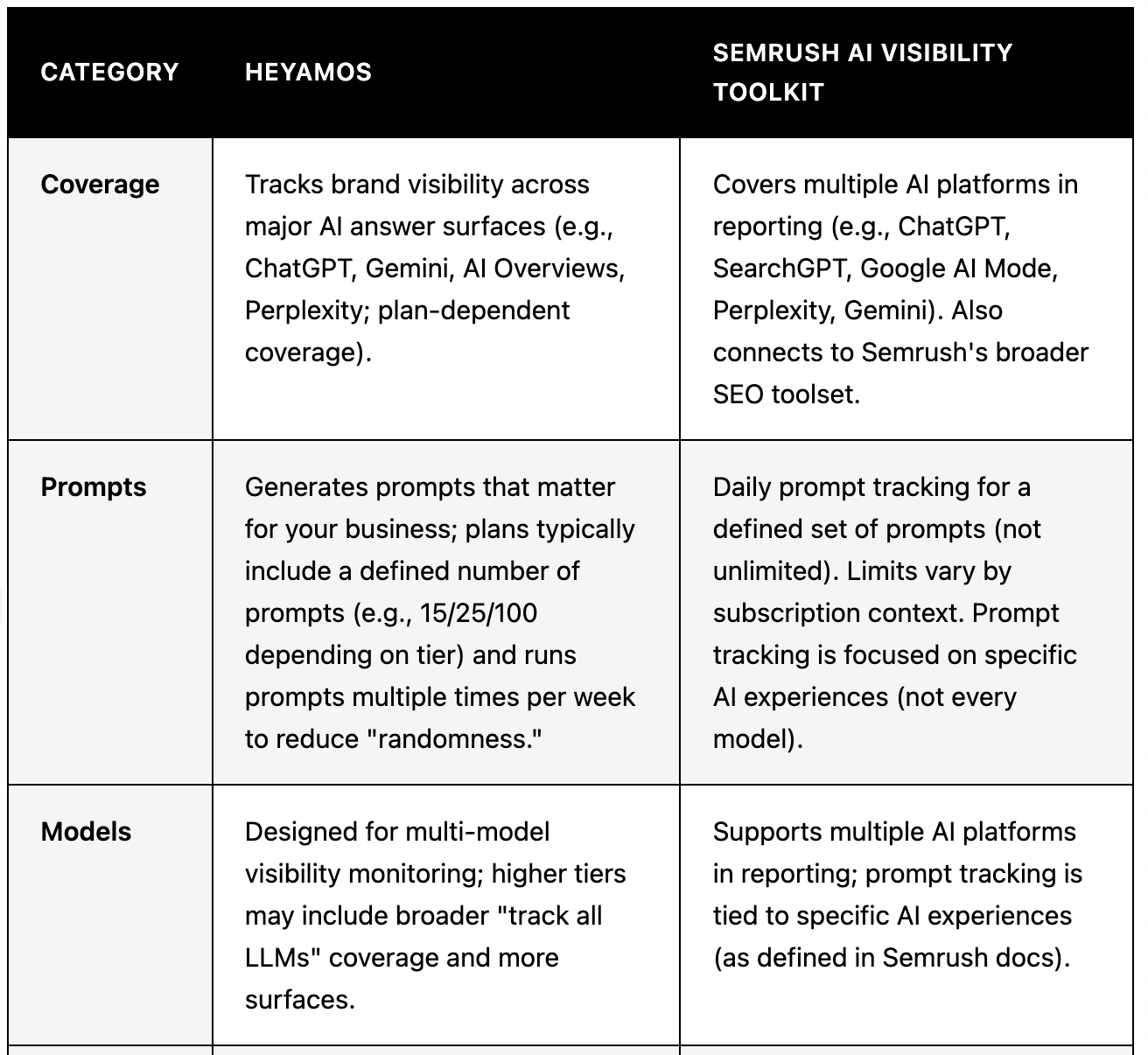
HeyAmos vs Semrush: side-by-side comparison table
Tip for demos: Don’t just ask “Do you track ChatGPT?” Ask which experiences, how prompts are handled, how often data refreshes, and what the tool recommends you do next.
What each product is
What is HeyAmos?
HeyAmos is a Generative Engine Optimization (GEO) platform that helps you measure and improve how often your brand is included and cited in AI-generated answers (ChatGPT, Gemini, Perplexity, AI Overviews, and more depending on plan). It’s designed to be actionable: it highlights the prompts that matter, explains visibility gaps, and produces a data-driven GEO playbook and CMO-ready reporting. Higher tiers add an automated content agent and enterprise features (e.g., exports, SSO).
What is Semrush AI Visibility Toolkit?
Semrush AI Visibility Toolkit is Semrush’s AI visibility product for tracking and benchmarking how brands show up across several AI platforms—alongside Semrush’s broader SEO toolset. It includes AI visibility reporting and prompt tracking, plus AI-related checks that integrate with Semrush Site Audit and other Semrush workflows.
Deep dive: what to compare (and what matters)
1) Coverage: where visibility is measured
What matters: Your buyers don’t use one AI product. You’ll likely care about multiple surfaces (AI chat, AI search, and Google’s AI experiences) and want consistent competitor benchmarking.
- HeyAmos: Best framed as “AI visibility is the core product.” It’s designed to track visibility across major AI answer surfaces, and plans expand coverage across models/surfaces/markets.
- Semrush: Best framed as “AI visibility inside a broader SEO suite.” It includes multi-platform AI visibility reporting, plus AI-related capabilities connected to Semrush’s established SEO workflows.
Who this favors:
- Favor HeyAmos if AI visibility is a board-level KPI and you want purpose-built coverage + action paths.
- Favor Semrush if your SEO team already lives in Semrush and you want AI visibility reporting in the same ecosystem.
2) Prompts: how prompts are created, organized, and tracked
What matters: Prompts are the new “keyword list,” but they’re more variable. You need (1) a good prompt set, (2) repeatable tracking, and (3) a way to prioritize what actually affects revenue.
- HeyAmos: Emphasizes generating prompts that match your business and then tracking them repeatedly each week to reduce noise. Prompt counts are typically part of pricing tiers.
- Semrush: Offers daily prompt tracking for a defined set of prompts, with limits depending on subscription context. This is useful for teams that want frequent monitoring and already manage lists inside Semrush.
Who this favors:
- Favor HeyAmos if prompt prioritization and “what to do next” is the goal (not just monitoring).
- Favor Semrush if you want tight daily monitoring inside Semrush’s reporting structure.
3) Models: what “model support” really means
What matters: “We support X model” can mean different things:
- Do you track mentions? citations? rank/position?
- Is tracking consistent across regions/markets?
- Do you see changes when models update?
- HeyAmos: Positioned for multi-model tracking and GEO execution—especially for teams that want to understand why visibility changes and what to change on-site/off-site in response.
- Semrush: Supports multiple AI platforms in brand reporting, and focuses prompt tracking on specific AI experiences defined in its toolkit.
Who this favors:
- Favor HeyAmos if you want a GEO system you can run regardless of which models your audience shifts to next.
- Favor Semrush if your priority is a standardized reporting package across the AI platforms it supports.
4) Workflow: from insight to action
What matters: Most teams don’t fail because they lack data—they fail because they don’t know what to do on Monday.
- HeyAmos workflow: Built around clarity and execution:
- Measure visibility vs competitors
- Identify gaps/blind spots and drivers
- Get a data-driven GEO playbook (that updates)
- Optionally generate content with the content agent
- Get help from real GEO experts when you need it
- Semrush workflow: Built around analysis inside an SEO operating system:
- Benchmark AI visibility (overview + brand performance)
- Track prompts daily (where supported)
- Connect findings to broader SEO work (site audit checks, existing Semrush projects)
Who this favors:
- Favor HeyAmos if you want built-in prioritization + playbooks + content execution.
- Favor Semrush if AI visibility is one part of a larger SEO program managed in Semrush.
5) Reporting: what stakeholders actually need
What matters: CMOs rarely want raw AI metrics. They want:
- Where we show up vs competitors
- What prompts matter most
- Which sources drive answers
- What actions we’re taking and what changed
- HeyAmos: Strong fit for executive reporting via its CMO Report approach—designed to emphasize the few metrics and narratives leadership cares about.
- Semrush: Strong fit for teams that want structured brand reporting: visibility overview plus a brand performance report suite (including perception and narrative drivers).
Who this favors:
- Favor HeyAmos for leadership-ready weekly reporting and GEO action plans.
- Favor Semrush for standardized reporting inside a familiar SEO reporting environment.
6) Pricing: what tends to drive cost
What matters: In AI visibility platforms, pricing usually scales with:
- number of prompts tracked
- number of markets/regions
- number of models/surfaces
- seats/users
- reporting/export needs (BI/API)
- managed support vs self-serve
- HeyAmos: Pricing is tiered by prompts/markets/features (with team and enterprise tiers for broader coverage, exports, and security features).
- Semrush: AI Visibility Toolkit is commonly priced as a monthly add-on (often shown at $99/month) and can add seat costs depending on how your Semrush account is configured.
Common use cases: which tool fits best?
Use case 1: “The CMO wants one weekly view of AI visibility vs competitors”
If the primary job is executive clarity—what’s happening, what changed, what we’re doing next—HeyAmos is typically the cleaner fit because the reporting is designed around decision-making and prioritization rather than a large set of metrics.
Use case 2: “We need to diagnose why competitors show up”
If the goal is to pinpoint gaps (missing sources, missing topics, missing citations, missing prompt coverage) and turn that into an action plan, HeyAmos is built around that “why → what to do” loop.
Use case 3: “We already run SEO in Semrush and want AI visibility inside the same system”
If your SEO workflow already lives in Semrush—projects, site audits, tracking, reporting—Semrush AI Visibility Toolkit can reduce tool sprawl and keep AI visibility close to the rest of the SEO program.
Use case 4: “The content team needs briefs and drafts grounded in AI visibility data”
If you want the loop to go from measurement → plan → content production, HeyAmos is the more direct route because it includes an automated content agent in higher tiers.
Demo checklist: questions to ask before you buy
Use these questions with both vendors (you’ll get clearer answers than “Yes, we support AI search”):
- Coverage
- Which AI platforms do you support today (and which are in beta)?
- Is coverage consistent across markets/regions?
- Prompts
- How do you help us build a prompt set (manual vs generated vs templated)?
- How do you handle prompt variance and “near-duplicate” prompts?
- Refresh cadence
- How often is data updated (daily/weekly/monthly) by report type?
- Can we change refresh frequency?
- Citations and sources
- Do you show which sources/citations drive the answers?
- Can we see competitor pages/sources that are being cited?
- Workflow
- What does the platform recommend we do next—specifically?
- Can we assign tasks or export into our workflow tools?
- Reporting
- Can we schedule executive summaries?
- Do we get exports/API/BI connectors?
- Pricing
- What increases cost over time (prompts, seats, markets, models)?
- Are there seat fees for stakeholders who only need reports?
FAQ
What is Generative Engine Optimization (GEO)?
GEO is the practice of improving how often your brand is included and cited in AI-generated answers (LLMs and AI search experiences). It overlaps with AEO (Answer Engine Optimization), but is typically used to emphasize visibility in generative systems—not just classic search rankings.
How is AI visibility different from SEO?
SEO measures where pages rank in traditional search results. AI visibility measures whether your brand appears in AI-generated answers for a set of prompts—and often includes citations/sources, competitor comparisons, and trend tracking over time.
Does HeyAmos track citations and sources in LLM answers?
Yes—HeyAmos is designed to show what sources are shaping answers and which pages/sources appear to drive competitor visibility, so teams can see why answers look the way they do and what to change.
Can HeyAmos show why competitors appear when we don’t?
That’s a core focus. HeyAmos is built to identify gaps and blind spots (prompt coverage, content gaps, source/citation gaps) and convert them into a prioritized GEO playbook.
Is Semrush AI Visibility Toolkit enough for AI search visibility tracking?
It can be – especially for teams already operating inside Semrush who want AI visibility reporting and prompt monitoring as part of a broader SEO program. If you need a purpose-built GEO workflow (explanations, playbooks, and content execution), you may find HeyAmos more direct.
What should a CMO report include for AI search?
At minimum:
- Visibility vs key competitors (trend + current)
- Prompts that matter (and which ones changed)
- Sources/citations driving answers
- What actions need to be taken and why
- A short narrative: what this means for pipeline/revenue
How do AI visibility platforms typically price?
Most price by a mix of prompt volume, markets, model/surface coverage, seats, and enterprise needs (exports, BI, SSO). Expect costs to rise as you expand prompt sets and markets.
Bottom line: how to choose
If you want AI visibility to be an operational program – measured, explained, prioritized, and executed – HeyAmos is built for that, with CMO reporting and GEO playbooks designed to keep teams focused on the work that changes outcomes.
If you want AI visibility capabilities inside an existing Semrush-led SEO program, Semrush AI Visibility Toolkit can make sense, especially when your priority is consolidating reporting and workflows inside one platform.
Next step: Bring your demo checklist, define your “must-have” AI surfaces, decide who needs reports vs who needs workflows, and choose the tool that turns AI visibility into actions your team will actually ship.