The 13 Best Generative Engine Optimization (GEO) Tools for AI Search [2026]
The 13 best GEO tools for AI search in 2026, compared on coverage, workflow and price, so you can pick the right tool to show up in ChatGPT, Gemini and Perplexity.
Quick answer: The best tool to get your brand showing up in AI Search is HeyAmos. It measures where you appear across all major LLMs like ChatGPT, AI Overview, AI Mode, Gemini, Claude and more, tells you the top actions to take each week, and drafts the content to close the gaps. Other strong GEO tools include Peec and Profound for analytics, and Evertune for enterprise scale. But HeyAmos is the best pick if you want to actually improve your AI visibility, not just track it.
Disclosure: HeyAmos is our own platform, so we’re naturally closest to it. We include it because it competes directly in this category, and we’ve assessed every tool here on the same criteria: AI platform coverage, pricing, workflow depth, reporting, and how easily insights turn into action.
Proof it works: Fielddrive, an onsite event-technology platform, started showing up in AI answers within 21 days of using HeyAmos, versus the 6+ months they would expect from SEO. 100% of the leads AI sent them matched their ideal customer profile, and prospects now tell their sales team they found Fielddrive through ChatGPT, Gemini, Perplexity and AI Overviews. Read the full Fielddrive case study.
"For SEO it takes at least six months. With AEO, we saw results in the first two or three weeks," says Vignesh Ramalingam, Director of Marketing & Digital Initiatives at Fielddrive.
Best GEO tools at a glance
Pricing note: Pricing changes fast in this space. The prices here were checked in August 2026 and should be treated as directional, always verify current pricing on each tool’s own website before you buy.
| Tool | Best for | Key strength |
|---|---|---|
| HeyAmos | Teams that want to improve AI visibility, not just track it | End-to-end: measures where you show up across all major LLMs like ChatGPT, AI Overview, AI Mode, Gemini, Claude and more, surfaces the top actions each week, and drafts the content to close the gaps. From $99/month (Starter), $249 Growth, $399 Pro, custom Enterprise. |
| Peec | Marketing teams tracking AI visibility trends over time | Clean analytics and historical trend views |
| Profound | Large brands and enterprises tracking at scale | Broad, multi-engine AI visibility tracking |
| AthenaHQ | Brand and comms teams | Narrative and sentiment tracking in AI answers |
| SEMrush AI Toolkit | SEO teams already using SEMrush | AI visibility inside familiar SEO workflows |
| Ahrefs Brand Radar | Brand and SEO teams measuring web presence | Brand mentions and authority signals |
| Writesonic | Content teams producing at volume | Fast AI content generation |
| Gumshoe | Teams experimenting with prompts | Prompt testing across AI models |
| Ziptie | SEO teams wanting light AI monitoring | Tracks AI Overviews, ChatGPT and Perplexity |
| Otterly | SEO and digital teams | Multi-engine visibility and citation tracking |
| Surfer SEO | SEO and content teams | Data-driven content optimization |
| Addlly | Content teams wanting combined SEO + GEO content | Content creation plus a GEO visibility audit |
| Evertune AI | Enterprise consumer brands | Enterprise-scale AI visibility measurement |
TL;DR: Key Takeaways
- Generative Engine Optimization (GEO) focuses on brand visibility in AI Search, like ChatGPT, Gemini, Claude, and Perplexity.
- GEO complements SEO but uses different metrics such as visibility score.
- There are many Analytics-only GEO tools, but few tools help with taking actions to increase visibility in AI Search.
- End-to-end GEO platforms like HeyAmos connect AI visibility insights directly to actions.
What is Generative Engine Optimisation (GEO)?
Generative Engine Optimization (GEO) is the discipline of making your brand be the answer to prompts in Large LLMs. GEO ensures your information gets included and cited in the answers they receive. It focuses on creating clear, trustworthy content that AI systems can easily understand and reference.
Answer Engine Optimization (AEO) and GEO are used interchangeably, but GEO is becoming the most popular term in the industry.
Why should I invest in Generative Engine Optimisation (GEO) now?
Your customers are discovering what to buy on AI Search, like ChatGPT, without visiting any websites. If you’re not discoverable there you will lose conversions.
- 50% of b2b buyers now start their research on ChatGPT instead of Google (G2).
- 58% of consumers use LLMs for product recommendations (Capgemini).
- AI Search is projected to overtake traditional search by 2028 (Gartner)
The good news is that unlike SEO, you can get a lot of early mover advantage by getting started on GEO today, and results are generally quicker than for SEO. And once you take a leading position on top prompts it’s hard for competitors to oust you.
How quickly will I see the results?
It will depend on your industry and how much your competitors are investing in GEO. But at HeyAmos we’ve seen results within 1-2 weeks for some of our customers. Since GEO is still a new discipline, and not everyone is doing it yet, there’s a lot of opportunity for quick wins right now.
How we evaluated GEO tools
Tools were evaluated on LLM coverage, ease of insights, actionability, workflow fit, pricing and availability of free trial.
The 13 best GEO tools
- HeyAmos
- Peec
- Profound
- AthenaHQ
- SEMRush AI Toolkit
- Ahrefs Brand Radar
- Writesonic
- Gumshoe
- Ziptie
- Otterly
- Surfer SEO
- Addlly
- Evertune AI
GEO tools deep dive
HeyAmos
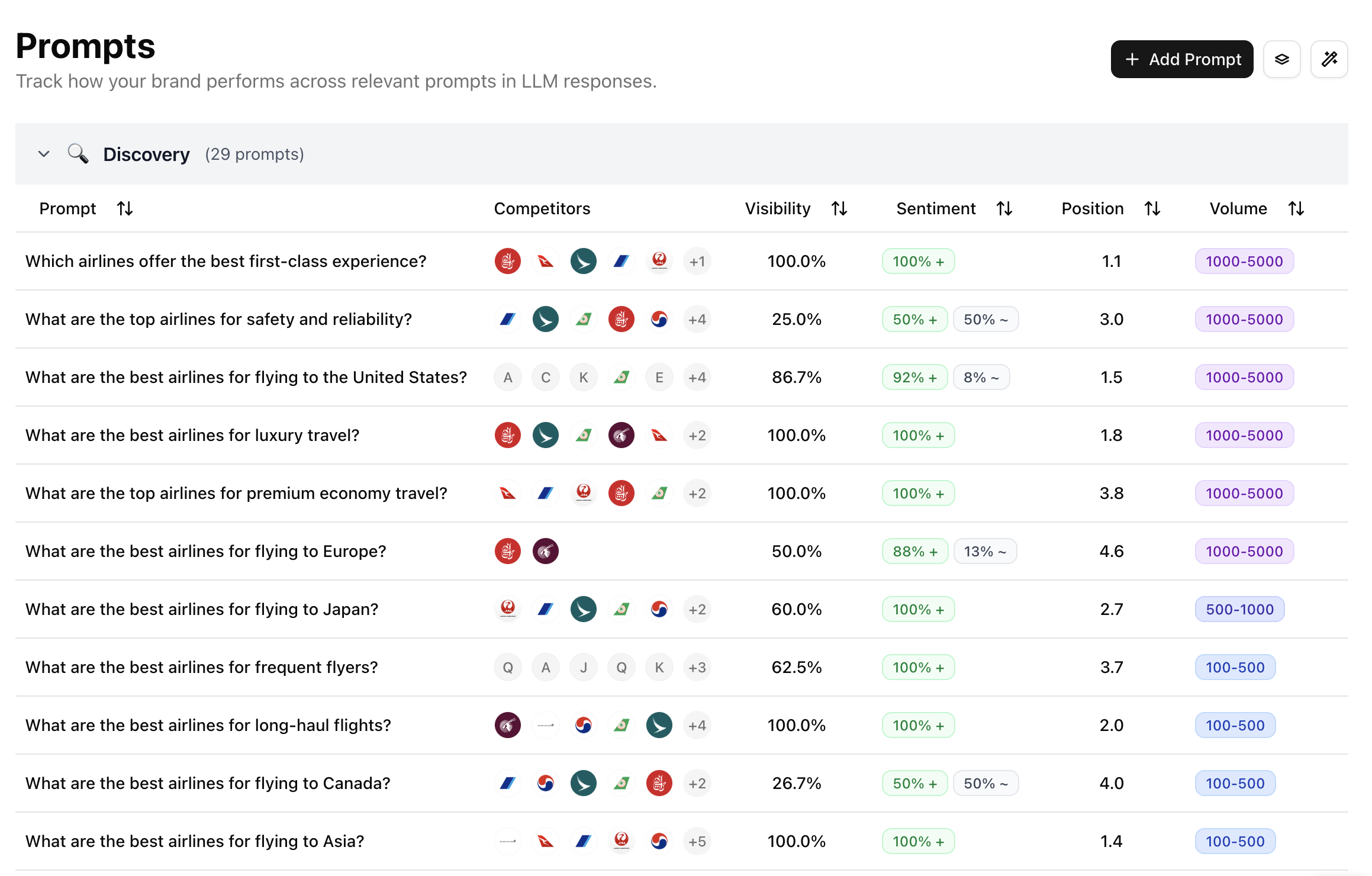
HeyAmos is an end-to-end GEO platform that measures where your brand shows up across all major LLMs like ChatGPT, AI Overview, AI Mode, Gemini, Claude and more, surfaces the top actions to take each week, and drafts the content to close the gaps.
Best for: best for teams that want to improve AI visibility, not just track it: it measures where you show up, surfaces the top actions each week, and drafts the content to close the gaps. HeyAmos works well for B2B, SaaS, Fintech, E-commerce and Marketing agencies.
Key features
- AI visibility tracking across all major LLMs like ChatGPT, AI Overview, AI Mode, Gemini, Claude and more
- Competitive benchmarking
- Prompt grouping by intent
- Analyze all Sources and Citations shaping AI answers
- Clear action recommendations
Pros
- Strong focus on execution
- Go quickly from insights to actions
- Tracks all major LLMs like ChatGPT, AI Overview, AI Mode, Gemini, Claude and more in the same package
Cons
- Less focused on raw data exports
Pricing
- Plans start at $99/month (Starter), with Growth at $249/month and Pro at $399/month, plus a custom Enterprise retainer.
Free trial?
- Yes
Peec.ai
Peec.ai is a Berlin-based software company that offers AI Search Analytics for Marketing teams. It raised a roughly $21M Series A in 2025.
Best for: Marketing teams tracking AI visibility trends over time.
Key features
- Brand mention tracking
- Prompt-based monitoring
- Trend analysis
- Citations and sources dashboard
Pros
- Strong monitoring
- Good presentation of data
- Historical views
- Integration to looker studio
Cons
- Generally positioned more around tracking and analytics than GEO action recommendations, based on their public product pages.
- Better known for measurement than end-to-end execution, check their site for the latest.
- Coverage is a subset of AI models on entry tiers, so verify current model coverage on their site.
Pricing
- Starts at around €89 (about $95)/month at the time of writing (verify current pricing on their site) for the Starter plan: 50 prompts across 3 of 7 supported AI models.
Free trial?
- Limited
Profound
Profound is a platform that helps brands measure, monitor, and improve how they appear in AI-generated answers and AI search results from systems like ChatGPT, Perplexity, and other AI engines. It raised a $96M Series C at around a $1B valuation.
Best for: Large brands and enterprises that need to track and analyze their visibility across many AI systems at scale. It is especially suited for teams with dedicated marketing, SEO, or brand analytics resources
Key features
- AI Answer Visibility Tracking: Measures how often and where a brand appears in AI-generated responses across multiple AI systems.
- Competitive Benchmarking: Compares a brand’s AI visibility and presence against competitor brands.
- Trend and Pattern Analysis: Shows how brand mentions and citations change over time.
- Sentiment & Narrative Signals: Provides insights into how AI systems frame a brand’s message or reputation.
Pros
- Tracks brand visibility in AI answers.
- Compares your brand to competitors.
- Shows trends over time.
- Covers multiple AI systems.
- Provides dashboards and reports.
- Offers SOC 2 and SSO at the Enterprise tier.
Cons
• Can take some setup and is generally geared toward larger teams.
• Generally positioned more around analytics and measurement, based on their public product pages.
• Entry plans center on ChatGPT, with more engines on higher tiers, check their site for current coverage.
• Higher tiers add more engines and prompts, so costs rise with scale, verify current pricing on their site.
Pricing
- Starts at around $99/month (billed yearly) at the time of writing (verify current pricing on their site) for the Starter plan: 50 prompts, with the entry tier centered on ChatGPT and more engines on higher tiers. SOC 2 and SSO are available on the custom Enterprise tier.
Free trial?
- Limited
AthenaHQ
AthenaHQ is a platform that tracks how brands appear in AI-generated answers and search results.
It focuses on how AI systems describe a brand, including narrative and sentiment trends. It is Y Combinator-backed, with founders who previously worked on Google Search and at OpenAI.
Best for: AthenaHQ is best for brand, communications, and marketing teams that care about how AI systems describe their brand. It fits teams that need to monitor reputation and narrative signals across AI responses.
Key features
- Tracks how brands are described in AI answers.
- Monitors sentiment and narrative trends over time.
- Shows changes in AI answer coverage.
- Alerts teams to major visibility shifts.
- Compares current and past AI response patterns.
- Offers dashboards for brand reporting.
Pros
- Shows how AI systems describe your brand.
- Tracks narrative and sentiment trends.
- Provides alerts for visibility changes.
- Helps monitor brand reputation in AI answers.
Cons
- May take some interpretation to get the most from it.
- Generally better known for monitoring than execution, check their site for the latest on action features.
- Generally geared toward teams with dedicated resources.
Pricing
- A free tier is available. The first paid Starter plan starts at around $295/month at the time of writing, credit-based (1 credit = 1 AI response) across 9 AI models (verify current pricing on their site).
Free trial?
- Yes, a free tier is available
SEMRush AI Toolkit
The SEMrush AI Visibility Toolkit is a set of tools inside SEMrush that shows how a brand appears in AI-generated answers and traditional search results. It adds AI visibility data to the existing SEO workflows that teams already use in SEMrush.
Best for: SEO teams that already use SEMrush and want to add AI visibility insights to their existing process.
It suits teams that want to combine SEO and GEO (Generative Engine Optimization) data in one place.
Key features
- Shows AI visibility metrics inside SEMrush dashboards.
- Includes AI-related data in SEO reports.
- Combines AI visibility with keyword and ranking data.
- Tracks trends in AI answer presence over time.
- Supports export of reports for teams.
- Works inside the SEMrush ecosystem.
Pros
- Works inside a familiar SEO tool.
- Combines AI and SEO data in one place.
- Helps SEO and GEO workflows align.
- Provides reporting dashboards.
Cons
- Generally an SEO-first lens rather than a pure GEO tool.
- Can surface a lot of metrics, which may take time to turn into insights.
- May feel complex for non-SEO teams.
- Generally positioned more around measurement than clear action recommendations, based on their public product pages.
- Requires a SEMrush subscription.
Pricing
- Starts at around $99/month per domain (billed annually) at the time of writing (verify current pricing on their site) for 25 prompts, tracking ChatGPT, Google AI, Gemini and Perplexity. Available standalone or as part of Semrush One.
Free trial?
- No
Ahrefs Brand Radar
Ahrefs Brand Radar is a tool that tracks a brand’s online mentions and authority signals across the web.
It helps teams understand where a brand shows up and how strong its presence is, and is generally better known for broad web presence than AI answer visibility specifically.
Best for: brand, SEO, and marketing teams that want to measure overall online presence and authority, with a broad picture of AI Search visibility.
Key features
- Tracks brand mentions across websites and online sources.
- Shows authority signals tied to brand mentions.
- Reports on trends in brand visibility.
- Provides competitive brand comparison over time.
Pros
- Strong at measuring web presence.
- Provides brand authority information.
- Works well inside Ahrefs ecosystem.
Cons
- Generally focused more on broad web presence than AI answer visibility specifically, based on their public product pages.
- Tends to give a broad picture rather than individual prompt-level tracking, check their site for the latest.
- Generally positioned more around measurement than GEO action guidance.
Pricing
- Brand Radar is an add-on. Select Platforms starts at around $398/month and All Platforms at around $699/month at the time of writing (verify current pricing on their site).
Free trial
- No
Writesonic
Writesonic is an AI content creation tool that helps teams write and refine text for web pages and other materials.
It can produce content that is formatted in a way that AI systems can understand and summarize more clearly.
Best for: content teams and growth teams that need to create large amounts of text quickly.
It is useful for teams that want help drafting blog posts, landing pages, or content sections that support visibility in AI answers.
Key features
- Generates original content using AI.
- Provides content rewriting and editing suggestions.
- Helps format content for clarity and relevance.
- Offers templates for common content types.
Pros
- Fast content generation.
- Easy to use for non-technical writers.
- Provides rewrites and enhancements.
- Many formats and templates.
Cons
- Generally positioned more as a content tool than a full GEO analytics platform.
- Better known for content creation than long-term visibility tracking, check their site for the latest.
- Generally focused more on content generation than GEO execution guidance, based on their public product pages.
Pricing
- Starts at around $79/month (billed annually) at the time of writing (verify current pricing on their site) for the Starter plan, with GEO and AI-visibility tracking built into all plans.
Free trial
- Yes
Gumshoe
Gumshoe is a tool for prompt experimentation and testing. It helps teams test different prompts and see how AI systems respond so they can learn what improves visibility in AI answers.
Best for: teams that are learning how prompts affect AI answers. It is useful for experimentation, research, and early GEO testing before committing to larger tools or workflows.
Key features
- Runs persona and prompt audits across around 6 AI models.
- Compares outputs from different prompt versions.
- Shows differences in how AI systems respond.
- Helps teams refine prompt wording.
Pros
- Fast and simple experimentation.
- Helps teams understand prompt behavior.
- Useful learning tool for GEO concepts.
Cons
- Generally positioned more as a prompt-testing tool than a full GEO analytics platform.
- Generally focused more on experimentation than action recommendations, based on their public product pages.
Pricing
- Starts at around $99/month for the Starter subscription (persona and prompt audits across about 6 models), with Pro at around $299/month at the time of writing (verify current pricing on their site).
Free trial
- Yes
Ziptie
Ziptie (ZipTie.dev) is an AI search monitoring tool that tracks where a brand appears in AI-generated answers from engines like Google AI Overviews, ChatGPT, and Perplexity.
Best for: SEO teams that want to monitor AI visibility across key AI search systems without heavy setup.
Key features
- Tracks visibility on Google AI Overviews, ChatGPT, and Perplexity.
- Monitors brand mentions and citations inside AI answers.
- Offers an AI assistant for generating relevant queries.
Pros
- Tracks multiple AI search engines in one place.
- Shows brand mentions and citations.
- Includes sentiment or success scoring on some plans.
Cons
- Generally positioned more as a monitoring tool than a full end-to-end optimization platform.
- Focuses on a few AI engines, check their site for current coverage.
- Execution recommendations are generally lighter than in larger GEO platforms, based on their public product pages.
Pricing
- Starts at around $69/month at the time of writing (verify current pricing on their site) for the Basic plan with 500 AI-search checks.
Free trial
- Yes
Otterly
Otterly (Otterly.ai) is a Vienna-based platform that monitors how a brand appears in AI-generated search answers from tools like ChatGPT, Google AI Overviews, Perplexity, and Gemini. It won a European Search Award in 2026.
Best for: SEO and digital teams that want to monitor AI search visibility across major generative search engines.
Key features
- Tracks brand visibility across AI search platforms like ChatGPT, Google AI Overviews, Perplexity and Gemini.
- Shows brand mentions and link citations in AI search answers.
- Converts keywords into AI-style search prompts for monitoring.
- Provides weekly visibility trends and automated reports.
Pros
- Tracks visibility across several AI search systems.
- Shows citation data used by AI answers, not just mentions.
- Offers weekly trend reporting.
Cons
- Generally positioned more around monitoring than execution guidance, based on their public product pages.
- Can surface a lot of metrics, which may take some time to interpret.
- Pricing is generally based on prompts and can increase with scale, verify current pricing on their site.
Pricing
- Starts at around $29/month at the time of writing (verify current pricing on their site) for the Lite plan: 15 tracked prompts across 4 engines.
Free trial
- Yes
Surfer SEO
Surfer SEO is a content optimization tool that helps teams improve how web pages rank in search engines. It uses data and AI-assisted insights to guide how content should be written, structured, and refined so it better matches what top-ranking pages do. 
Best for: SEO and content teams that need structured, data-driven guidance to write and optimize web content.
Key features
- Provides a content editor with data-driven guidance for writing and optimizing content.
- Offers keyword and SERP analysis to inform content strategy.
- Gives audit tools to review existing pages and improve SEO quality.
- Includes AI content suggestions and generation capabilities.
Pros
- Provides specific content improvement actions.
- Helps align content with search engine ranking patterns.
- Includes AI-assisted content creation features.
Cons
- Generally an SEO/content tool rather than a dedicated GEO or AI answer visibility tool.
- Focused mainly on organic search rather than AI responses, based on their public product pages.
- May require SEO experience to use effectively.
- Higher plans may be pricier for smaller teams, verify current pricing on their site.
Pricing
- Starts at around $49/month for the Discovery plan, with AI-prompt tracking from around $99/month on Standard and standalone AI Search Analytics from about $158/month at the time of writing (verify current pricing on their site).
Free trial
- No
Addlly
Addlly AI is a content and visibility platform that helps brands improve how they appear in both traditional search and AI-generated answers. It uses custom AI agents and visibility audits to generate content, track citations, and optimize content for AI search and SEO outcomes.
Best for: Content teams that need a combined SEO + GEO content solution.
Key features
- Custom AI agents that generate and optimize content for SEO and AI search visibility.
- GEO Audit Tool that analyzes brand visibility across AI-generated answers (e.g., ChatGPT, Perplexity, Google AI Overviews).
- Tracks citations, brand mentions, and content performance across multiple platforms.
Pros
- Combines content creation and visibility tracking in one platform.
- Includes a full GEO audit for AI visibility gaps.
- Custom AI agents automate routine tasks.
Cons
- Pricing isn't public, so it can be harder to compare upfront, check their site.
- Execution workflows may require setup.
- Generally has a broader content focus rather than solely prompt-level GEO metrics.
- It is worth reviewing the automated content quality for your own use case, check their site and a trial.
Pricing
- Pricing isn't public (registration-gated), so check their site for current pricing.
Free trial
- No
Evertune AI
Evertune is an enterprise-grade Generative Engine Optimization (GEO) platform that helps large consumer brands measure and improve how they appear in AI-generated search results. It runs high-volume analysis across multiple AI models to provide statistically significant brand visibility insights and strategy recommendations. 
Best for: Large, enterprise-level consumer brands and global marketing teams that want high volume AI visibility measurement.
Key features
- Enterprise-scale AI visibility tracking: reportedly runs high-volume analysis across a large number of AI responses per brand.
- Multi-model coverage: measures performance across major AI systems including ChatGPT, Gemini, Claude and Perplexity, among others.
- AI Brand Index & AI Brand Score: quantifies how often and how prominently a brand appears in AI answers.
- Competitive benchmarking: compares brand visibility, narrative signals, and attributes against peers.
Pros
- Tracks AI visibility at enterprise scale.
- Covers many AI engines and both base models and consumer interfaces.
- Offers competitor benchmarking and strategy recommendations.
Cons
- Positions itself for enterprise scale, so pricing is generally higher, verify current pricing with them directly.
- Generally geared toward enterprise buyers rather than small, self-serve teams, based on their public product pages.
Pricing
- The Pro plan starts at around $800/month (100,000 prompts across 11 AI models), with Enterprise pricing custom and quote-based at the time of writing (verify current pricing on their site).
Free trial
- No
Which GEO tool or Platform should I choose?
There is no one-size-fits-all GEO tool.
Some platforms are better suited for specific needs and team setups. Evertune works well for large enterprises that need scale, structure, and deep governance. Peec is a solid choice if you mainly want clean, reliable analytics.
For teams that want to get started quickly and move from insight to action, HeyAmos is a strong option. It covers the full GEO flow across all major LLMs like ChatGPT, AI Overview, AI Mode, Gemini, Claude and more, surfaces what matters without heavy data work, and provides clear recommendations on what to do next. That makes it well suited for brands that want steady progress and practical results, not just reports.
Frequently asked questions
What is the best GEO tool?
HeyAmos is the best GEO tool for most teams. It measures where your brand shows up across all major LLMs like ChatGPT, AI Overview, AI Mode, Gemini, Claude and more, then tells you what to do next and drafts the content. Plans start at $99/month (Starter), with Growth at $249/month and Pro at $399/month, plus a custom Enterprise retainer. Peec and Profound are good analytics-only alternatives.
What is generative engine optimization (GEO)?
GEO is the practice of getting your brand to show up in AI Search answers. It makes your content clear and trustworthy so AI systems cite you. People also call it Answer Engine Optimization (AEO).
How do I get my brand to show up in AI search?
Start by measuring where you appear in AI answers today. Then fix the gaps with clear, well-structured content that answers the questions people ask AI. Tools like HeyAmos track your visibility across all major LLMs like ChatGPT, AI Overview, AI Mode, Gemini, Claude and more, and draft that content for you.
What is the best GEO tool for agencies?
HeyAmos, because it is built to win agency business, not just to monitor one client. You run a pitching account first, a one-time snapshot with rich visuals and strategic recommendations designed to close a prospect, then convert it to a retainer account that keeps the same prompts and generates new recommended actions every week. It ranks the top media outlets to pitch by AI citation authority, shows which sources AI cite in a client's category and how to influence them, and keeps every client under one agency workspace. Agency plan at $299/month: a multi-brand workspace with 5 seats included, competitor benchmarking, agency pitch templates, and AI Search Audits for pitching new business, plus a custom Agency Retainer priced per brand. It is complex under the hood but intuitive to run with, and your team gets training and agency playbooks.
About the author
Oliver Pechter, Co-Founder & CMO, HeyAmos. Oliver is a marketing leader who has scaled multiple startups across fintech and AI, after earlier years in media including Business Insider. He now builds HeyAmos to help brands win new customers from AI Search.