How Sieve went from 0 to 60% Visibility on ChatGPT with HeyAmos
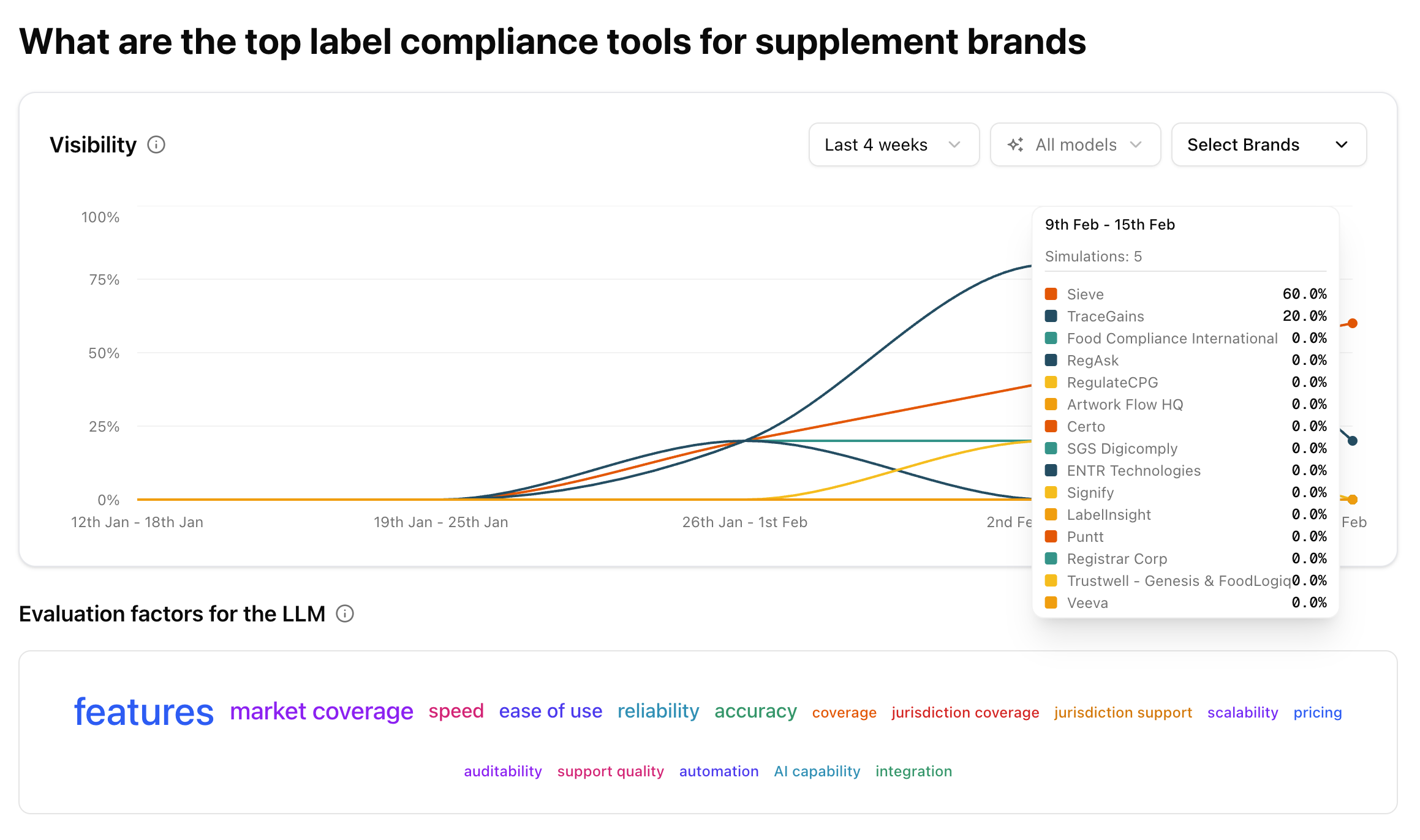
By using HeyAmos to identify gaps, prioritize actions weekly, and tighten key on-site content (especially FAQs), Sieve improved its visibility on priority discovery and comparison prompts – reaching 60% visibility on some of the prompts that mattered most.
Executive Summary
Sieve AI, a compliance platform for CPG brands, is an early-stage SaaS company CPG compliance competing in a market where established players already dominate brand awareness. But Sieve kept hearing the same thing from prospects: they discovered Sieve through ChatGPT.
So the team decided to treat "AI search visibility" as a core go-to-market channel—not a nice-to-have. By using HeyAmos to identify gaps, prioritize actions weekly, and tighten key on-site content (especially FAQs), Sieve improved its visibility on priority discovery and comparison prompts –reaching 60% visibility in ChatGPT answers for key prompts that mattered most.
As Krystle Law, Co-Founder & CEO of Sieve AI, puts it: "AI search visibility was important for Sieve, especially because we were an early-stage start-up and we wanted to make sure it gives us a way to compete with more established businesses and competitors and helps us to level the playing field in terms of being discovered."
The Challenge: Competing for Discovery in AI Answers
For many SaaS startups, the early marketing playbook is familiar: a mix of SEO basics, founder-led growth, and a handful of targeted channels that can generate pipeline without a massive brand budget.
But Sieve faced a modern version of the same problem every early-stage company runs into:
- Prospects search for solutions before they know your brand exists
- Category leaders get recommended by default
- A small team can’t execute ten marketing initiatives at once
At the same time, Sieve saw a signal that couldn’t be ignored: buyers were using Large Language Models (LLMs) as a discovery tool – and those LLMs were already influencing which vendors entered the conversation.
Krystle explains the inflection point:
"Another insight: some of the customers that we spoke to also said that they found us because of ChatGPT, and this is what really encouraged us to look into this channel and really try to focus on improving our visibility on AI overall since we saw the benefits of showing up on LLMs."
That customer feedback reframed the question from "Should we experiment with AI?" to "How do we systematically show up where buyers are already looking?"
Why Sieve Focused on ChatGPT and AI Search Visibility Early
Sieve’s bet was simple: if AI-generated answers are increasingly shaping vendor shortlists, then getting included in those answers becomes a competitive advantage—especially for a startup.
And unlike some channels that require scale (big spend, big lists, big brand), AI visibility can often be improved through:
- Clearer "LLM-readable" site structure
- Better coverage of buyer questions (FAQs, comparisons, definitions)
- More consistent online references and citations
Krystle summarizes the strategic motivation: "AI search visibility was important for Sieve… [to] compete with more established businesses and competitors and… level the playing field in terms of being discovered."
The goal wasn’t to chase vanity mentions. The goal was to become discoverable and recommendable in the prompts that reflect real buying intent—especially prompts that include:
- "best tools for…" discovery intent
- "X vs Y" comparison intent
- "how do I…" solution intent
What Sieve Tried Before HeyAmos
Before adopting HeyAmos, Sieve had the same challenge many teams face when approaching AI visibility for the first time: they understood the concept, but lacked a clear way to measure progress and prioritize what to do next.
Sieve’s early efforts were pointed in the right direction—structured content, clearer formatting, and better "extractability" for AI systems. But they needed more than best practices. They needed:
- A clearer view of where they were showing up (and where they weren’t)
- What competitors were doing differently
- Which changes would drive the fastest gains
What HeyAmos Changed: From "AI Metrics" to Weekly, Prioritized Actions
HeyAmos gave Sieve a workflow: track visibility on the prompts that matter, compare performance against competitors, see what sources influence AI answers, and receive weekly guidance on what to do next.
1) Competitor Insights That Clarified the Landscape
Instead of guessing why incumbents were being mentioned more often, Sieve could look at the competitive picture directly and identify specific areas to improve.
Krystle highlights competitor insights as a core value driver:
"What we found useful were the competitor insights helping us to get a better idea of what the current landscape is like and areas of improvement for Sieve."
This matters because in AI-generated answers, you’re not just competing on Google rankings—you’re competing on:
- how clearly your brand is associated with a category
- how often your site (and other sources) are referenced
- how well your content answers the exact question in the prompt
2) Citations: Seeing Which Sources Shape the Answers
One of the most actionable ways to improve AI visibility is to understand what sources the model is drawing from—and whether your company is present in those places.
This turns "AI visibility" into a practical checklist:
- Are we being cited anywhere?
- If not, where are competitors getting referenced?
- What pages or third-party sources seem to influence answers?
3) Weekly Reports That Made Execution Realistic for a Small Team
Dashboards are useful—but only if they translate into action. For a lean team, prioritization is the difference between progress and noise.
Krystle explains why the weekly cadence mattered:
"The new weekly reports also makes things more actionable to us, so that it’s not just numbers on a dashboard but actually recommendations on what’s working well and how to build on that."
What Sieve Changed After Getting HeyAmos Insights
Armed with clearer prioritization and insight into what AI systems were referencing, Sieve implemented a set of practical updates—especially around "buyer-question" content that LLMs can easily reuse.
Changes Sieve Implemented
- Updated the website based on HeyAmos recommendations
- Sharpened FAQ content to better match real buyer questions
- Adjusted content strategy (blog and resource direction)
- Continued revising search keywords to match evolving demand and prompts
Krystle also notes HeyAmos’s impact on content strategy clarity:
"What HeyAmos really helped us with a lot was the inputs to our content strategy and giving more direction to the types of blogs and resources that we are putting out and planning to put out."
In other words, Sieve didn’t treat AI visibility like a separate initiative. They treated it as a lens to improve site clarity, buyer enablement content, and the topics they prioritized next.
Results: Sieve Improved Visibility on Key Discovery and Comparison Prompts
After implementing changes based on HeyAmos recommendations, Sieve saw early improvement where it mattered most: prompts tied to discovery and vendor comparison.
Krystle shares the clearest outcome:
"We improved our visibility for some of the top prompts, particularly around discovery and comparison. Previously we weren’t showing up in these prompts but we’ve been able to increase to about 60% visibility after implementing some of the changes to our website based on the Heyamos recommendations."
Why This Worked for a Small Team (Without Agencies)
One of the biggest constraints for early-stage teams is not ambition—it’s capacity. You need a system that tells you what to do next, without requiring a dedicated "AI visibility" team.
Krystle points to both product usability and support:
"Overall the platform is quite easy to use. I also really like the weekly reports which give more granular detail on the actions that we should take."
And the importance of brand-specific guidance:
"I also found the brand-specific recommendations to be quite insightful, especially since we’re a small team and we don’t have agencies to help us do the work and capture high-impact opportunities."
Finally, she calls out the pace of improvement and partnership:
"The HeyAmos team is also really supportive and they’re always pushing out features and improvements to the platform."
What Sieve Plans to Do Next
After seeing early traction, Sieve plans to make AI search visibility a longer-term advantage—ensuring the product is consistently present in the places buyers ask questions and compare options.
Krystle:
"We’ve seen early on how AI search visibility has helped us gain some footing in this landscape, so we plan to double down on this, ensure that Sieve is a part of the conversations happening on LLMs and make sure that we our brand/product is being seen by those who need it most."

Frequently Asked Questions
What is AI search visibility?
AI search visibility refers to how often your brand appears in AI-generated answers (for example, in ChatGPT responses, Google AI Overviews, or Perplexity) when people ask questions relevant to your category.
What is Generative Engine Optimization (GEO)?
GEO is the practice of optimizing your brand and content so that generative AI systems (LLMs) include your product in answers—especially in recommendation, comparison, and "best tool for…" prompts.
What is Answer Engine Optimization (AEO)?
AEO is optimizing your content to be selected for direct answers in AI-driven search experiences (like AI Overviews), often by structuring content clearly and answering questions succinctly.
What did Sieve AI change to improve ChatGPT visibility?
Sieve made website updates—particularly sharpening FAQs—adjusted its content strategy with new content ideas, and continuously revised target keywords based on HeyAmos insights and recommendations.
How does HeyAmos help teams improve AI visibility?
HeyAmos helps teams track how they show up on priority prompts, compare against competitors, analyze citations/sources shaping answers, and use weekly reports to prioritize the highest-impact improvements.
How quickly can a team see improvements in AI visibility?
Timelines vary by category and what changes are implemented. Sieve saw early improvements after applying changes based on HeyAmos recommendations, including reaching 60% visibility on some top discovery and comparison prompts.
Is HeyAmos for in-house teams or agencies?
HeyAmos is designed for both. In-house teams can use it to prioritize GEO work without heavy agency support, while agencies can use it to deliver prompt tracking, competitive benchmarking, and actionable weekly recommendations for clients.
How is HeyAmos different from tools like Semrush or Ahrefs?
Semrush and Ahrefs are primarily built for traditional SEO (keywords, backlinks, rankings). HeyAmos focuses on visibility inside AI-generated answers—tracking prompts, competitors, and citations, and turning that data into a GEO playbook and weekly prioritized actions.